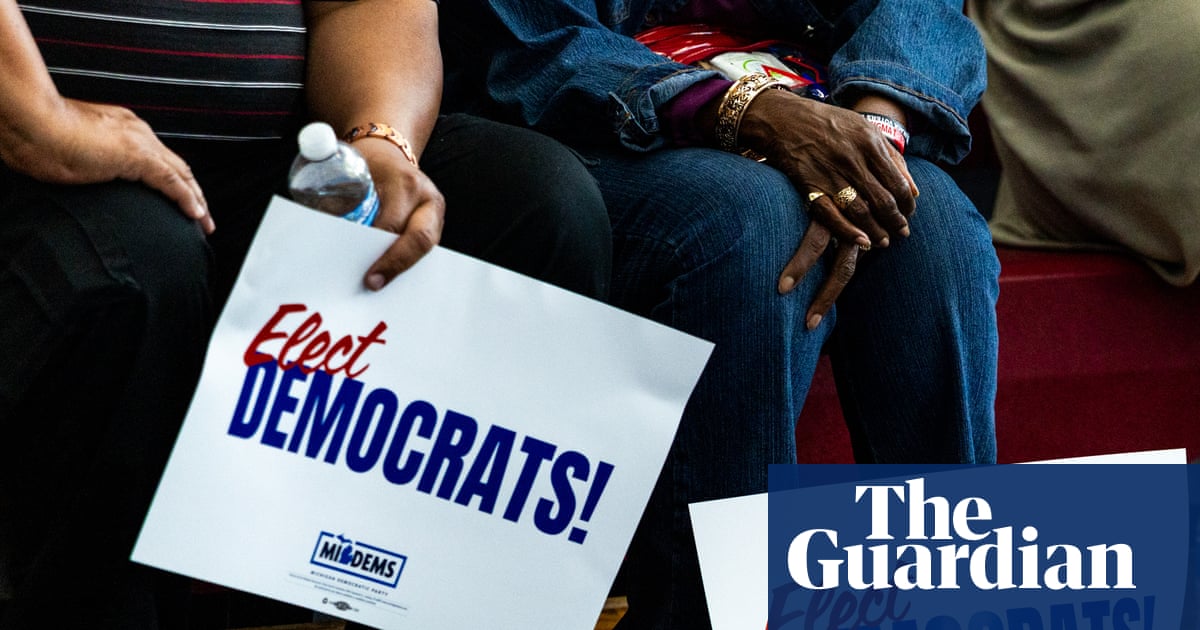

The blue wave, while a rebuke of Trump’s policies, was also a referendum on the party’s status quo
On election night I stood in a crowd at Harlem Tavern, a restaurant in New York City, at the electoral party for Darializa Avila Chevalier, the Democratic Socialists of America (DSA) member and congresswoman-elect from New York’s 13th congressional district. The crowd cheered as what came to be called the “blunami” rolled in: Iowa blue, Kansas blue, Talarico in Texas, Abdul El-Sayed in Michigan, House, Senate, gubernatorial races overwhelmingly going for the Democratic party.
The victories were a clear rebuke of Trump’s politics, but also a referendum on the Democratic party’s own centrism that is complicit in the violence of masked men hunting immigrants, the funding of a genocide and the denial of healthcare to citizens of the world’s wealthiest country.
Constants do not produce change. It was a Democratic party committed to “centrism” that lost the House in 2022. A promise to maintain the status quo did not win Kamala Harris the 2024 presidency. And while some want to point to centrist victories in this blue wave, what is newsworthy is how Democratic politics have, in the last two years, shifted towards progressives and socialists, in campaigns powered by people and their small donations rather than big corporations and their money.
Take the wins of eight card-carrying democratic socialists who are entering the House of Representatives, three of whom – Avila Chevalier, Melat Kiros and Donavan McKinney – unseating establishment candidates to do so. Avila Chevalier, who was an immigration organizer and part of the student encampment, ran because her opponent, Adriano Espaillat, refused to meet with Mahmoud Khalil’s family when he was abducted by ICE and refused to call for its abolition.
Their victories were facilitated by Zohran Mamdani’s mayoral win in New York last year. But what paved the way for him, and them, I have argued, was the pro-Palestine movement that put their body on the line and that made it so that most Democrats are sympathetic to the Palestinian cause.
It is a shift that the American Israeli Public Affairs Committee (Aipac) itself recognized when they declared that they will no longer endorse candidates or give campaign contributions; that their money was now toxic and served as a flag to Democratic voters not to support their candidates.
Senators-elect Troy Jackson and El-Sayed – who are progressive, but not DSA members – have also called what’s happening in Palestine a “genocide” and won contentious competitions doing so in Maine and Michigan respectively. James Talarico in Texas said “God is screaming at all of us in Gaza as we speak”.
A similar thing happened with regards to other social movements. Today 77% of Democrats (and half of all Americans) support abolishing ICE, a position incredibly unpopular in the last two decades that activists have been organizing for it.
Democrats, who have long been in bed with tech, ran against AI datacenters, pushed by organizers who emphasized its destruction of the environment, water supply and social effects on everything from student learning, theft of intellectual property, to the creation of nonconsensual porn.
But these problems, while shaping candidate platforms, were secondary to economic issues for most voters. Gallup polling just before the election showed healthcare (68%) as the number one issue that registered Democrats found “extremely important”. An earlier poll from You-Gov indicates what they want: a staggering 85% of Democrats support Medicare for All.
The same Gallup poll showed that for Democratic voters it’s not just the economy that’s the top concern for their vote, but specifically “income and wealth distribution” (65%) over and above gas prices (53%). Said in a different way it’s not just “affordability” that people want, it’s affordability through justice and social programming – it’s redistribution ie socialist policy.
The blue wave is cause for celebration – the Democratic party is in a two party system, the only alternative we currently have to a Republican party that has gotten unfathomably brutal, that wears white supremacy like a crown.
However, the Democratic party too is a part of the same political machinery that has funded ICE administration after administration. That has funded the genocide in Gaza. That did not succeed in enshrining healthcare for all, or cancelling student debt. That has not brought us the progressive, socialist policy that Americans crave. And it is unclear, despite this pressure from voters, that the party is going to do differently this time.
Hakeem Jeffries, who is running for speaker of the House, will not commit to holding a vote on abolishing ICE. He opposes Medicare for All. He has said he will not hold Trump accountable for the human rights violations committed, portraying it as a question of “getting even” rather than achieving justice where it was denied. Chuck Schumer, who holds similar positions, has an extraordinarily low approval rating – yet plans to run for majority leader in the Senate. Electeds are questioning whether these men should hold these roles.
But the dissent must also come from us, as it has been. We need to demand an end to the fast violence of guns on our streets trained on our neighbors, bombs dropped from the sky and the slow violence of people dying because their healthcare was denied or their food stamps were cut.
We need to organize, and mobilize, to demand the multi-racial democracy we were promised – not a playground for the rich to get richer on the time and labor and lives of the poor.
Heba Gowayed is an associate professor of sociology at CUNY Hunter College and Graduate Center and author of the book Refuge: How the State Shapes Human Potential.