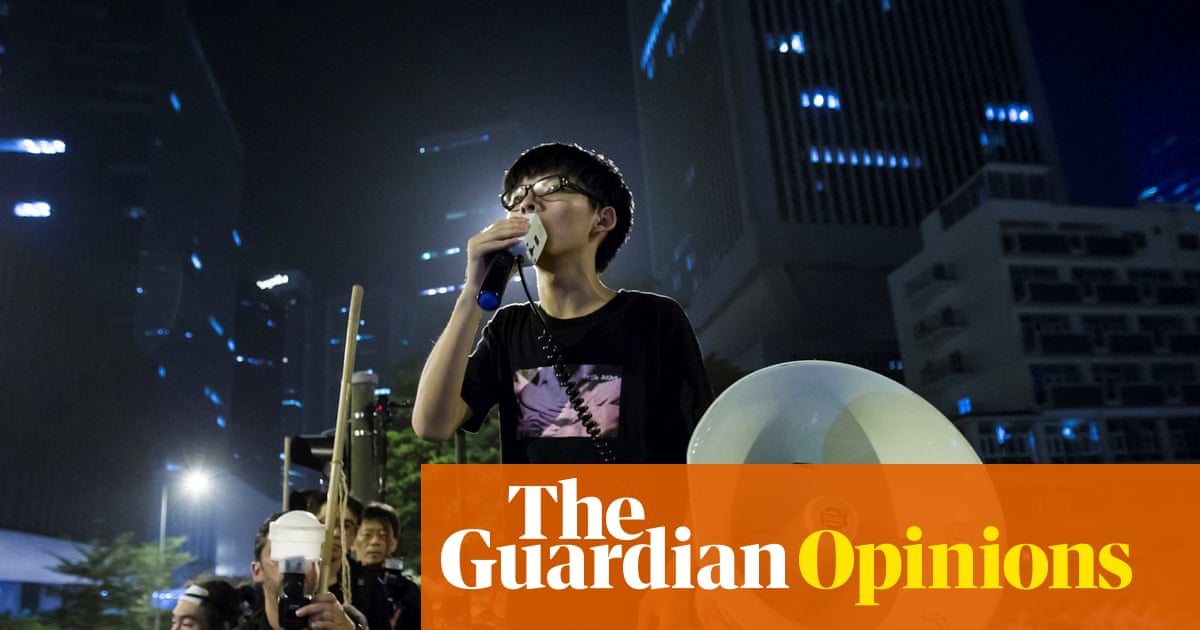
My friend Joshua Wong was due to be released next January. Under draconian security laws, his sentence has been extended by 10 years
Two years ago, I wrote in this newspaper about the lengthy imprisonment of my friend Joshua Wong, who I spent years campaigning alongside for the advancement of Hong Kong’s democracy. He was given an unjust sentence meant to keep him behind bars until January 2027. He was supposed to be released in a few months, when I hoped he would finally be able to reunite with his friends and family and embark on a new chapter.
But this hope was misplaced. The end of the tunnel isn’t next year; it’s late 2036. By then, he will be 40. On Thursday, Joshua was sentenced to another 10 years under Hong Kong’s national security law for colluding with foreign forces. He is the only political prisoner who’s been convicted twice under the national security law. The judge described Joshua and me as “two ringleaders or masterminds” urging foreign powers to impose sanctions and other hostile actions against the Chinese and Hong Kong governments. The judgment cited previous international advocacy work, media interviews, social media posts and the political activities of Demosistō, the youth-led democratic party we founded.
Much of the cited evidence predates the implementation of the national security law, even though the court insisted it was not being applied retrospectively. Before 2020, meeting with foreign parliamentarians, engaging with and speaking to international institutions, and advocating for measures against human rights abuses were ordinary campaign strategies. These were peaceful means through which we tried to hold those in power accountable. The campaigns raised the profile of Hong Kong’s protests and garnered substantial support; they were so effective that Beijing had to impose the national security law to curb them and impose extensive legal punishments.
There is a stark lack of evidence about Joshua’s actions. Prosecutors said that he conspired with campaigners including myself to ask foreign bodies to impose sanctions on China – relying on his sharing of Facebook posts written by me. But these posts did not directly call for sanctions – they made other appeals, including for digital forensic companies to terminate their cooperation with the Hong Kong police. There’s no evidence that Wong himself advocated for imposing any form of sanctions, or that he had any direct link to advocacy work outside Hong Kong. The court also accepted that no organisation or funding supported his activities after the law came into force.
Still, as flimsy as the evidence is, it’s enough to secure him a decade in jail. The crux of the trial is not legal; it’s political. It is clear that Beijing exercises sweeping control over Hong Kong’s legal and political systems. This can be seen in the tightening of the electoral system by introducing an Iranian-style vetting mechanism, in the jailing of peaceful political dissidents and the emphasis placed on the necessity of “patriots ruling Hong Kong”.
When Chinese leaders categorise Jimmy Lai, Benny Tai and Joshua Wong as the “masterminds” behind the 2019 pro-democracy protests, the legal system must deliver sentences that reflect the trio’s “importance”. That’s why Lai and Tai have been sentenced to 20 years and 10 years respectively, and rank among the most persecuted pro-democracy figures in the region. There are now close to 2,000 political prisoners in Hong Kong.
It’s devastating that Joshua has been behind bars for such a large portion of his adult life. I couldn’t even imagine skipping 16 years before I reached my 40s – during which time many people meet their partner, get married, raise a family and settle into a career. Joshua has been deprived of living fully because of his advocacy for important democratic values. The sentence signals to the world that China is determined to quash any hopes for freedom and democracy on its soil.
As geopolitical competition intensifies and populism rises, human rights are increasingly treated as an inconvenience to diplomatic and economic interests. Governments speak of stability and pragmatic engagement, while political prisoners slowly disappear from international public attention. The Chinese regime has little reason to change its approach if the repression of Hong Kong carries no meaningful consequences, either to trade or its global standing.
Given that Hong Kong was a British colony until as recently as 1997, the UK, in particular, should not regard the territory as merely another foreign policy issue. The Sino-British joint declaration was intended to safeguard the city’s rights and freedoms. The British government should therefore make the release of Joshua, Jimmy Lai and other political prisoners a priority when dealing with Beijing, rather than responding to each new sentence with another ineffective statement of concern.
For months, I had imagined the day Joshua would finally be free. Now that hope has been pushed away for another decade. We must not forget him, and must take urgent action to demand his immediate release.
Nathan Law is a pro-democracy activist and former legislator from Hong Kong. He is a political refugee in the UK
Do you have an opinion on the issues raised in this article? If you would like to submit a response of up to 300 words by email to be considered for publication in our letters section, please click here.