
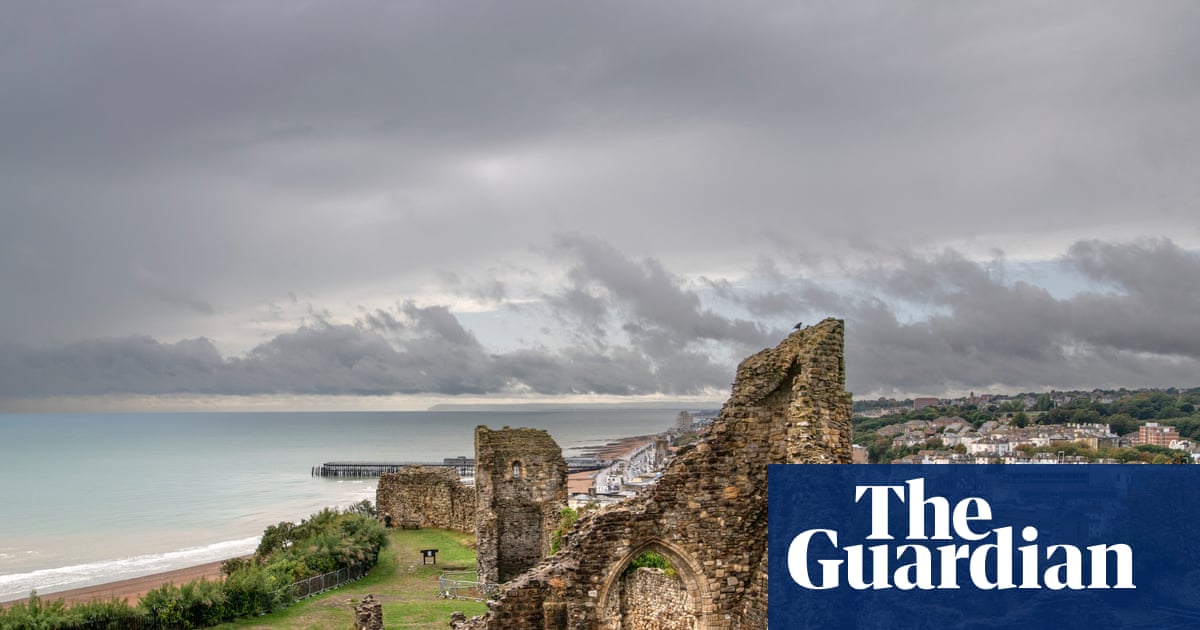
William the Conquerer-built Hastings Castle and Swiss-style writing retreat in Kent two of nearly 200 additions to list
A castle built by William the Conquerer, a Swiss-style chalet where Charles Dickens wrote and a swathe of fire-blasted moorland are among sites that have been added to Historic England’s heritage at risk register.
Almost 200 historic places have been added to the already extensive list, including Hastings Castle in East Sussex, Dickens’ wooden writing retreat in Kent and Fylingdales Moor in North Yorkshire, which was devastated by a wildfire in the summer.
Some of the stress on the sites is being put down to the climate emergency, with hotter summers and stormier winters placing some of England’s most treasured places in greater peril.
Historic England also highlighted more cheerful stories, with sites ranging from a historic Cornish fishing harbour to a rustic West Country hut regarded as the birthplace of vaccinations being removed from the list.
Emma Squire, the joint chief executive of Historic England, said the 197 additions were diverse, and she accepted some people would be surprised that such high-profile sites could be in danger. “It highlights that even places regarded as very special can sometimes be at risk of decay or loss,” she said.
Hastings Castle was one of the fortifications commissioned by William the Conqueror after the Norman invasion of 1066 to secure his position along the English south coast. Historic England said the exposed setting and coastal erosion had long shaped the ruins, but recently sections had become vulnerable because of extreme weather events.
Squire said: “More extreme weather events and coastal erosion are definitely themes. Water ingress and subsidence feature more than they have done in the past because of changing weather patterns.”
Dickens’ writing chalet in Rochester has been added to the register because it is judged to have become fragile and in need of repair. The wooden two-storey building originally stood in Dickens’ garden at Gads Hill Place in Higham, Kent, and served as a getaway where he could work undistracted.
He is thought to have positioned mirrors to help him rehearse for his public performances and develop new characters. The chalet was moved to its present position in Rochester in the 1960s.
The Fylingdales Moor wildfire in 2025 caused damage to about 25 sq km of moorland and forest, according to North Yorkshire fire and rescue service.
Historic England said it affected thousands of people living and working in the area as well as having a major impact on the natural environment. It has been working with the North York Moors National Park Authority using drones to help assess the damage.
Also added to the list is Hall’s Croft in Stratford-upon-Avon, Warwickshire, the historic home of William Shakespeare’s daughter. Funding is needed to save the exterior of the 17th-century timber-framed building, including repairing damage caused when it was hit by a vehicle.
The 18th-century Bidston windmill in Wirral, Merseyside, which has spectacular views of Liverpool and the Welsh mountains, has also been added. A friends group keeps it open but urgent repairs are needed.
Historic England said 85 sites had been “saved” and removed from the register, including Newlyn harbour, one of Cornwall’s most important fishing ports. Local specialists have restored its granite structures and 19th-century wrought iron railings.
In Haringey, north London, 810 Tottenham High Road, a Georgian terrace house, has been saved from dereliction by Tottenham Hotspur FC, with support from the National Lottery Heritage Fund, and is now a creative hub with artists’ studios, galleries and a cafe.
Edward Jenner’s hut in Berkeley, Gloucestershire, a rustic summerhouse described as the site of the world’s first vaccination clinic, has also been saved.
Historic England said it spent more than £12m on grants for support and repairs to 135 sites on the heritage at risk register during 2025-26.
There are still almost 5,000 sites on the list, including 1,500 secular buildings, 1,000 places of worship, three battlefields and four wrecks.
The heritage minister, Fiona Twycross, said: “This year’s register is an important reminder of the pressures facing our historic environment, from ageing buildings and structural deterioration to the impacts of extreme weather.”