Set designer for the Royal Shakespeare Company and National Theatre who had an insatiable curiosity about other cultures
There was upheaval in the world of British theatre design in the 1980s when, said Peter Hall, director and founder of the Royal Shakespeare Company and Laurence Olivier’s successor at the National Theatre, the stage “explored a new world of space and lightness, of suggestion rather than actuality, of eclecticism rather than period accuracy”.
A crucial participant in this upheaval was the spirited and inspirational Pamela Howard, who has died aged 87. She was deeply embedded in the contemporary European theatre, and also influenced by the earlier visionary, exploratory theatre design projects of Adolphe Appia and Edward Gordon Craig, as 19th-century stage realism was challenged, and Caspar Neher, Bertolt Brecht’s mid-20th-century designer, placed the actor in a brightly lit alternative world without decorative furniture or antimacassars.
Howard, who worked not only with the National and the RSC but also with such prominent French directors as Roger Planchon and Ariane Mnouchkine in, respectively, Lyon and Paris, was an unfettered internationalist not only as a designer, but also as a teacher, producer and curator, on account of her own sense of Jewish alienation.
She felt her work was never complete without an accompanying exhibition, and that work spilled out of her drawings, poems, teaching, love of music and insatiable curiosity about other cultures. As early as 1974 she worked on Planchon’s stunning version of the French Revolution, Blues, White and Reds, at the Birmingham Rep.
At Chichester in 1984, she designed The Merchant of Venice, with Alec Guinness as a furtive, well-graced Shylock shuffling among Howard’s huge peeling walls of the ghetto. And for an RSC touring production by Di Trevis of The Taming of the Shrew in 1986, with Alfred Molina and Siân Thomas, she combined a Fellini-esque carnival of colour with Napoleonic costumes, contained within a festive pavilion of a long white canopy, the audience and cast so interfused that the production did not seem to be “designed” at all.
The following year, at the National, with Trevis directing, she cracked a major problem with the flat stage of the NT’s Lyttelton, averred Michael Billington, by inventing an ingenious hillocky surface against an evocative astral backdrop for Molière’s fierce comedy School for Wives. Roger Lloyd Pack and Celia Imrie headed that cast. Also with Trevis at the National that year, Juliet Stevenson was Lorca’s Yerma in the rectangular Cottesloe (now Dorfman) hung with linen drapes; that simple spectacle endorsed the play’s mood of domestic drudgery, sexual frustration and tragic barrenness.
Major international productions included the Venezuelan folk opera Rondo Adafina (2002) – sub-titled “a soup in seven movements” – chronicling the migration of Sephardic Jews to Caracas; Martinů’s opera The Greek Passion (the composer’s libretto based on a novel by Nikos Kazantzakis) in its first manifestation on Greek soil, at Thessaloniki in 2005; and the world premiere, in Brno in 2010, of the first version of Janáček’s wonderfully surreal The Excursions of Mr Brouček to the Moon.
This immersion in foreign work and cultures was how Pamela lived her life. Her maternal Jewish grandparents emigrated from Minsk, Belarus, finding themselves in Newcastle, not New York, as they had expected. Their daughter, Ann Gatoff, married Joseph Hoffman, whose parents had emigrated to the East End of London from Riga in Latvia. Joseph changed his surname to Howard and met Ann in Newcastle – he knew one of her brothers – where he had gone looking for work as a travelling salesman. Pamela, born in the city, was the first of their three daughters. The younger two were born after the second world war, when Joseph returned from serving abroad, and the family moved to Birmingham, where Joseph formed a business mending the scales on weighing machines.
Pamela – who had spent the war with her mother, a dressmaker, and grandparents, and attended Wingate Road primary school in Newcastle – was expelled from Kings Norton grammar school for girls after drawing a picture of a hotel during a maths exam. Remarkably – she was nothing if not determined – and unaided by her parents, she talked herself into a grant to attend the Birmingham college of art and design, having been advised that her hands were not strong enough to fulfil her childhood dream of becoming a concert pianist (after taking lessons from Sylvia Fenby, daughter of the composer Eric). Then she was accepted, through making contact with Georges Wakhévitch, the great Russian theatre and ballet designer, on the theatre design course at the Slade in London in 1958.
While still a student she volunteered as an assistant on the 1958 premiere of Benjamin Britten’s Noye’s Fludde at the Aldeburgh festival and painted a large rainbow on a double bed sheet hanging from the village hall in Orford. This experience nourished her soon-to-be-zeitgeisty appetite for making theatre in non-theatrical spaces.
In 1959, she was working in the paint shop at the Birmingham Rep and from there developed over the subsequent two decades her reputation as a designer – or scenographer – in Britain, the US and Europe. She was a tutor on the design course at the Central School of Art and Design in London from 1974 until 1986 and design course director there from 1987 until 1991; “I teach what I practise, and I practise what I teach,” she said.
She served for many years as the international chair in drama at the Royal Welsh College of Music and Drama and was a guiding light on the Prague Quadrennial, the most important showcase for international theatre design since its foundation in 1967; Britain won top prize there in 1979, 1991 and 2003.
Her intense collaborative adventure with the Scottish playwright and director John McGrath yielded Border Warfare (1988), an account of the England v Scotland wars from 1200 AD onwards in the Old Transport Museum in Glasgow. Her design took us from a primeval forest to a football pitch on four mobile stages with the audience promenading and 12 actors and five musicians playing 600 roles. Impossible, but breathtaking.
“The oldest magic of theatre,” she said, “is finally its greatest strength. Freed from normal theatre conventions, exhilarated at seeing things played in unexpected places by performers with, often, transcendent skill, audiences are themselves transformed, capable of understanding more than they have heard, and of imagining more than they could possibly have seen.”
Howard wrote What Is Scenography (2001), explaining her holistic approach to theatre work and, with Pavel Drábek, a lecturer and now professor emeritus at Hull University, The Art of Making Theatre (2022), an engaging mix of autobiography and aspiration in the arts.
She was married twice, firstly, in 1959, to Michael Mills, who worked in computers, and with whom she had two daughters. They divorced in 1980, and in 1989 she married, briefly, the Hispanist Robert Potter, whom she had met in 1987 and with whom she later adapted (as well as directing and designing) a new version of Fernando de Rojas’s 15th-century classic La Celestina for the Hopkins Center in New Hampshire in 2002.
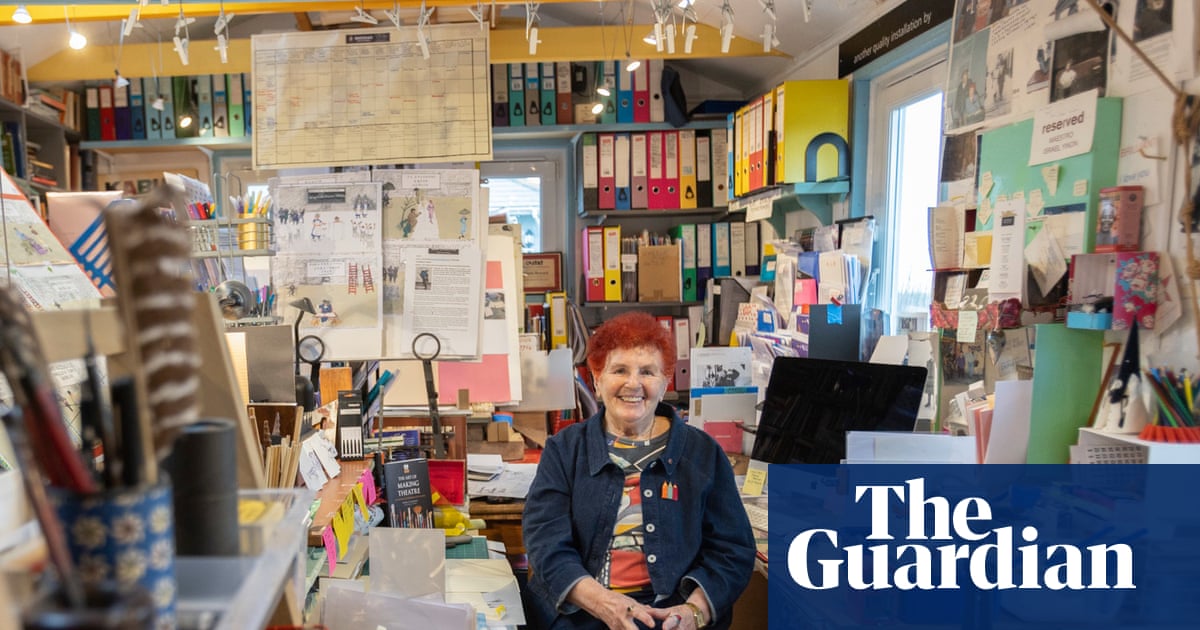
In 2003, she moved from London to Selsey in West Sussex, where she lived alone, surrounded by her work and her design memorabilia, drawings and posters in two converted railway carriages just two dozen yards from the beach, with a studio in the garden. She never stopped working and had just returned from receiving an honorary doctorate in Romania when she died.
She was made OBE in 2008 and is survived by her daughters, Rebecca and Sophie, and by three grandchildren, Benjamin, Lily and Dylan.