
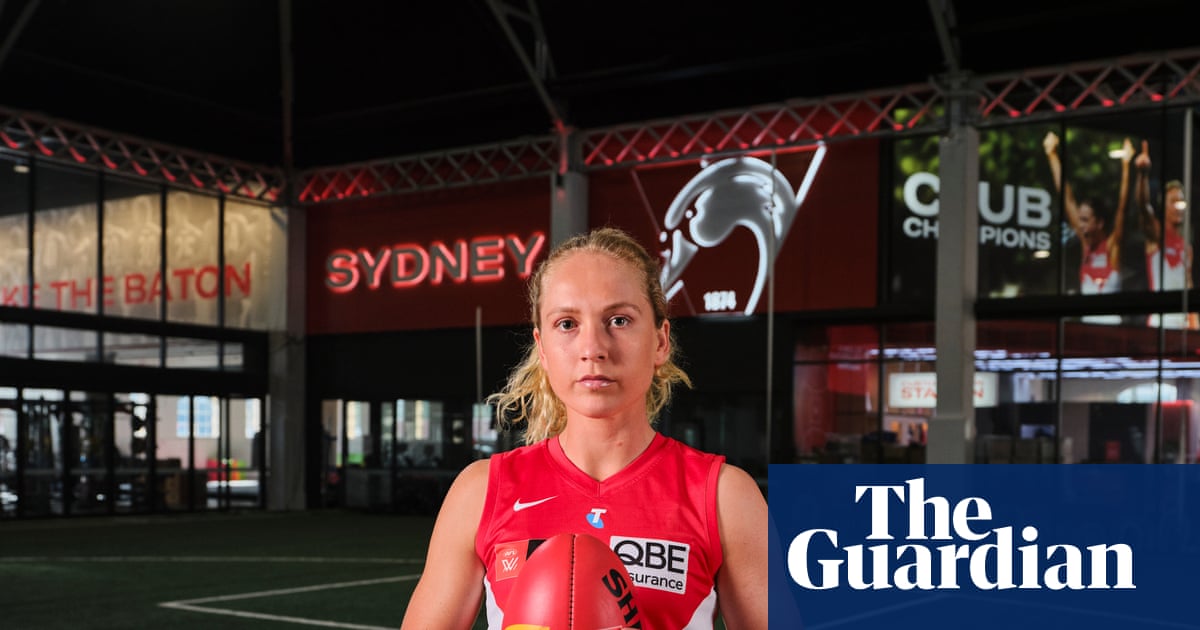
Swans midfielder Dr Lulu Pullar, who plays her seventh final this weekend, says one of the best ways to connect to her patients is through football
Lulu Pullar’s boss has given her this Saturday night off work. As an emergency doctor at Sydney’s St Vincent’s hospital, a typical shift sees her treating patients in acute mental health distress, people affected by drugs and alcohol, and victims of road trauma and domestic violence. The public health system, she tells Guardian Australia, is under enormous strain across the country.
“It’s not just doctors but all healthcare workers – nurses, allied health staff, volunteers,” Pullar says. “It can be a stressful environment for everyone – and especially scary for patients. But it’s also an incredibly supportive place to work. Everyone’s willing to go the extra mile to make sure we’re refreshed and in the right headspace to best care for our patients.”
Instead of donning scrubs this weekend, Pullar will prepare for her seventh final as an AFLW player, with Sydney taking on Western Bulldogs in an elimination final on Sunday. Growing up in Brisbane, she ran, swam and played soccer. Her family were Australian rules nuts in a rugby league town. But there were no girls footy teams. Her soccer skills earned her a scholarship at the prestigious University of Southern California in Los Angeles and a stint at Brisbane Roar in what was then the W-League. But a career in medicine was always calling, and professional footy wasn’t even on the radar.
At first, footy was a way to decompress from the demands of study. But it was obvious she was good at it too. Pullar was an outstanding runner, a fierce competitor and adapted to the sport quickly. First at Brisbane, and then at North Melbourne, she cut her teeth at two of the best women’s programs the sport has seen. She never had much luck with injury, due in no small part to the long hours she spent on her feet as a junior doctor. But she has become a key cog in this Sydney side, cementing her spot on a wing in this her second season with the club.
“There haven’t been many bursts of brilliance in my sporting career, whether it be soccer or footy,” Pullar says. “It’s more a case of passion and perseverance. I find that saying ‘yes’ has taken me a lot of places. And I’ve been so lucky in terms of the support I’ve had from the club but, more importantly, from the hospital. I would never use the word ‘balanced’ but this season has probably been less intense in terms of trying to juggle work and footy.”
Whether the Swans’ season finishes this Sunday or later this month, Pullar’s attention will then turn to her charity, Dreamd Academy, a series of camps and community programs with young Indigenous women in central Australia. As a kid, she and her family regularly visited remote communities. As a young doctor working in the emergency department at Alice Springs hospital, she treated victims of domestic violence and chronic health conditions that were a world away from her work in inner city Sydney.
“I quickly found that one of the best ways to connect with my patients was through football,” she says. “It’s such a good way for a doctor from Sydney to break down the barriers with an Indigenous woman from a remote community, a woman for whom English might be their second language. But something as simple as talking about footy, or even kicking a footy, is a beautiful way to learn about their lives, to yarn with them, and establish trust.”
At first, she was training with the Redtails Pinktails Right Tracks program, which had been operating in Alice Springs for several decades. It was a way of keeping fit in between shifts. She trained with men and women. Some were just out of prison. Some she had treated at her hospital. One, Doreena Hansen, was recently awarded a scholarship to do a week of pre-season training with the Swans.
The Dreamd Academy includes clinics, school holiday programs and women’s health workshops. Some women travel as much as eight hours to take part. Earlier this year, Pullar and her team built and fully equipped a gym, giving the women year-round access to strength training.
In this part of Australia, there have been too many initiatives that have been tied up in good intentions and bureaucratic knots. Pullar has worked tirelessly to put the right philanthropic, corporate and community structures around it to ensure its impact is long lasting.
“In many ways, the footy season and the footy finals is my least busy time of year,” she says with a laugh. “With the charity, I’m constantly working on it – constantly calling coaches, participants, volunteers. It’s a bit of a Fifo business right now but I’m trying to be as supportive and productive as I can be from afar.
“I’m tapping into one of the greatest things about remote Australia – that sense of community. People living there depend on each other so much more than in the big cities. It’s the same thing that has kept me in sport so long – that sense of support, that community, that knowledge that the person next to you has got your back.”