
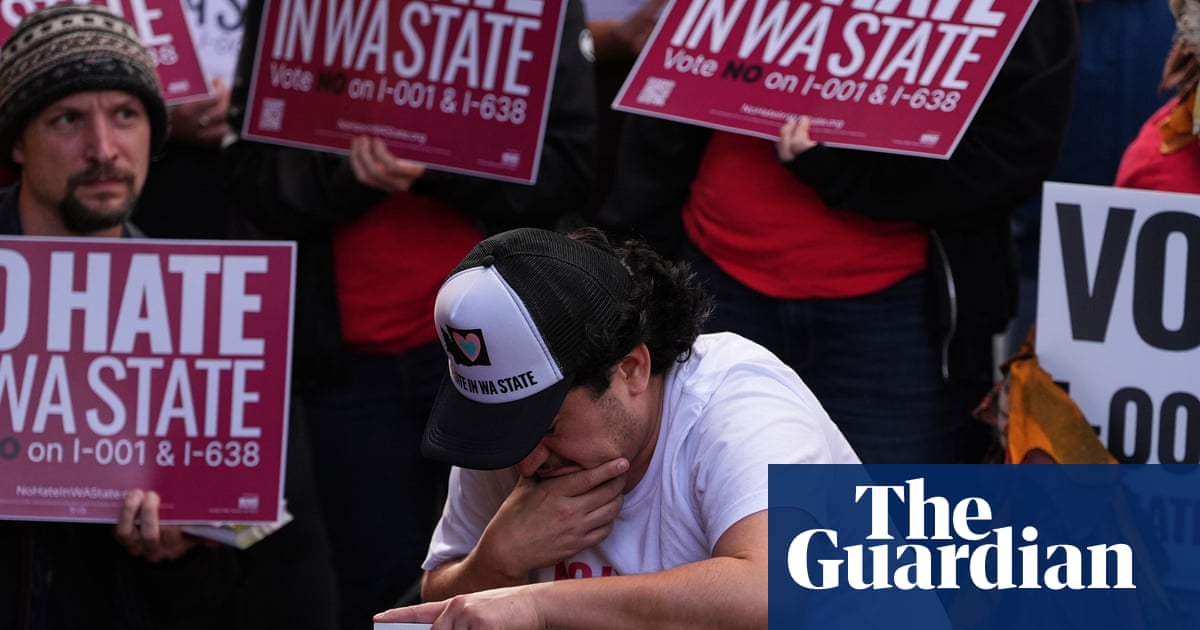
Legal challenge against ballot initiative that bans transgender girls’ participation in girls’ school sports is poised to set off a battle over rights
A coalition of advocacy groups are preparing to mount a legal challenge against a Washington state ballot initiative that bans transgender girls’ participation in girls’ school sports, which voters approved in last week’s midterm election and will go into effect next month.
The challenge is poised to set off a protracted legal battle over the rights of trans youth in Washington, which has functioned as a safe haven for thousands of trans people fleeing states that have enacted anti-trans laws in recent years.
If enforced, the ballot measure, Initiative 638, would be “the most extreme” trans sports ban of its kind, according to its opponents. The initiative’s official text says it would require all girls participating in school sports to “verify biological sex”, which could include confirming their “reproductive anatomy”. Opponents say that language potentially subjects tens of thousands of girls to invasive genital exams in order to participate in girls’ school sports.
“There are parents that are going to be asking, ‘Is my kid going to have to have a choice of dropping their pants in front of a complete stranger or missing the track season?’ We don’t know the answer right now,” said Lexi Koren, a spokesperson for No Hate in Washington State, the campaign against I-638.
Advocates say the state’s courts represent the likeliest path forward for any litigation, given relevant legal precedent, as well as strong state-level privacy and anti-discrimination statutes.
The initiative was put forth by Let’s Go Washington, a conservative political group that has backed 20 ballot proposals since its founding in 2022. Washingtonians voted against the group’s two other initiatives on the ballot this year, including an effort to repeal the state’s new income tax on high earners, and Initiative 001, which would have forced schools to share sensitive student records with parents. Initiative 638 holds a double-digit lead in its favor – approximating the Democrats’ projected national popular vote margin during the midterms.
“I don’t think, unfortunately, that the blue wave is really applicable to trans people,” said Danni Askini, executive director of Gender Justice League, a trans advocacy group based in Washington State.
According to a source familiar with the impending legal challenge, the coalition spearheading the lawsuit includes local and national groups, including the ACLU of Washington, Planned Parenthood, and No Hate in Washington State. The lawsuit would be filed before 3 December, when the initiative’s enforcement will go into effect. The source added that, while I-638’s forcing girls, and not boys, to verify their sex might violate federal legal precedent, the US supreme court is a less likely venue for the advocates’ lawsuit, in part given some of the court’s past rulings on trans rights.
Washington state case law suggests courts may strike down measures tying participation in school sports to potentially privacy-violating policies. In 2008, the Washington state supreme court ruled against a school district’s random drug tests of student athletes, affirming that the state’s constitution offers privacy protections beyond those guaranteed by the federal constitution.
Trans advocacy groups have been working against Let’s Go Washington over the past four years, when the conservative group’s efforts to pass a measure like Initiative 001 began. By forcing schools to share sensitive details about students with their parents, the initiative potentially constituted a “forced outing” of trans and queer students, said Koren of the No Hate campaign, framing Initiative 001’s defeat as a win for trans youth.
In addition to a new Democratic supermajority in the state legislature, Washington may soon have a liberal supermajority in its state supreme court; both chambers could play a role in defeating I-638, depending on how challenges against it move forward.
Jaelynn Scott, who was elected last week as Washington’s first openly trans state legislator, said “the infrastructure for LGBTQ power building” had “deeply weakened” after marriage-focused legal activism had wound down. Without adequate campaign funding and organizing against I-638, much of the public failed to understand the initiative and “how it was codifying discrimination into law”, she added, noting that some of her constituents likely voted for both her and the trans sports ban.
“If for some reason the legal challenge doesn’t work, then in the state legislature we damn sure are going to repeal that law in two years,” Scott said.