Primary school students bested 200,000 competitors across New South Wales to reach the Premier’s Spelling Bee finals in Sydney
Get our breaking news email, free app or daily news podcast
Competing in a spelling bee is not for the faint of heart. Sometimes, the difference between victory and loss is one incorrect vowel and you’re undone, months of training reduced to nought.
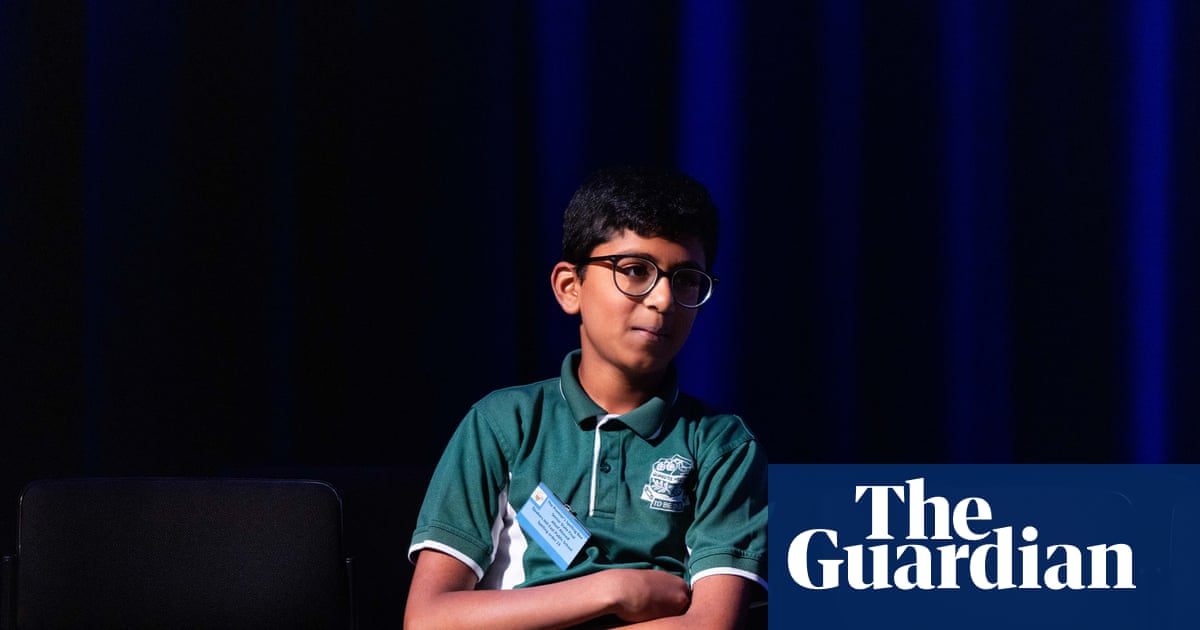
At a small theatre hall in Sydney’s west on Friday afternoon, 34 primary school students sit stony-faced on a brightly lit stage, knowing this pressure only too well.
All have made it past about 200,000 students who competed in spelling bees across 1,070 public schools in New South Wales. The finalists earned their place at this year’s state competition after winning online regional finals in August. They represent the top 0.03%. And they’re not here to mess around.
Five are competing for a third time, having progressed to the last stage in the junior competition. Among them are year 5 student Wafiq Ayyash from the Hunter region, who won the junior state title in 2024, and year 6 student Bobby Ivaneza from the inner west, who was runner-up the same year.
Ewan Mattick from the state’s central west, Caleb Borg from the Riverina, and Alesha Kahfandi from the Hunter have also qualified for the state finals on three occasions. This isn’t their first rodeo.
The format is relatively simple. Contestants begin with “seen” words that they’ve been able to practise at home, before facing “unseen” words testing their broader skills and composure. Each round is sudden death.
To kick off, they’re introduced to the crowd by the host, ABC presenter Rae Johnston, with colourful details.
Archie Griffith likes the Parramatta Eels and his dachshund puppy. He doesn’t like his dad’s jokes. Ivaneza, who is wearing a bright red sweatband, admires Nicola Tesla, a Serbian-American engineer who died in 1943, for his genius. Ivaneza’s favourite food is camembert.
The students are as diverse as the schools they come from. Some 23 speak a language other than English at home, and 18 have travelled from outside Sydney.
Seven go down in the first round, stumbling over obscure words like “tourmaline” and “malapropism”. Another seven are out in round two – but you try spelling “lepidopterist” at home.
In the next four rounds, 13 students fall. Mattick nails “centurion” and gives a thumbs up to his family. Come round seven, Kahfandi begins to pray.
“Pernicious” and “sagacious” bring two more students down. And then there are five: Afeef Ahmed, Ivaneza, Kahfandi, Caroline Wang, and Maximilian Lumley, all in year 6. Two are returning finalists.
In round eight, they all spell their words correctly, though Ivaneza, usually breezing through with confidence, restarts on “whimsical”. Then, in round nine, he’s asked to spell “unserviceable” and omits the second “e”.
Ivaneza, visibly devastated, slumps into his seat and places his head in his hands. The remaining students spell their words correctly, and Ivaneza tearily returns to his family in the crowd and the comforting embrace of his father. The heartbreak is palpable.
Then, in an instant, after Ahmed correctly spells “immemorial”, the remaining three competitors fall. Kahfandi misses “antepenultimate”, Wang gets tied up by “parmigiana” and Lumley is one letter off getting “genealogy”. Ahmed has won.
But the show must go on.
“We are in an interesting situation,” Johnston says. “We need to play for a runner up.” Wang goes out straight away after being dealt the word “grandiloquent”. But Kahfandi and Lumley appear to be in lockstep. For the next five rounds, they’re either both correct or both wrong.
“We’re just going to keep on going,” Johnston declares. It begins to feel that the audience will grow old in this theatre, steadily working its way through the entire Macquarie Dictionary.
But then, Kahfandi misses the word “vociferous”. Lumley approaches the microphone and awaits his fate. His word is “apocalypse” and, after a deep breath, he nails it.
The crowd bursts into cheers, and Lumley returns to his seat and stares reflectively at the ground, looking like he has endured a war. His grandmother, Sue, is bursting with pride. “It was so stressful,” she says, “and he looked so calm.”
“He’s worked so hard. Some of those words, I didn’t even know what they were. We’re very proud.”
Kahfandi is proud of herself, too. “It was very tense in the room, there was a lot of pressure on everyone,” she says. “I feel a bit disappointed I didn’t get second and I was a bit tired after all those rounds, but getting third place is also really good.”
Ahmed is surprised he’s won, but his mother isn’t. She’s been helping him train for months – half an hour every night before bed.
“He reads a lot,” she says. “I knew he would win; he was three-time champion at school.”
Asked how he felt when he found out he’d won Ahmed says, at first, he “didn’t realise”.
“But then when they said we had a winner, I felt happy,” he says. “The runners-up words were harder than the ones I got.”